In the beginning, there was the Ottoman Empire—initially a small country founded past a Muslim Turkish tribe, which gradually grew into a multiethnic, multireligious entity extending from Vienna to Yemen. Lasting for about 6 centuries, from the early fourteenth century to the end of Globe War I in the early twentieth, the empire left behind a definitive legacy with which Turks take been struggling ever since, in complex ways.
The Ottoman Empire was a Sunni Islamic land. Sharia, or Islamic law, constituted its fundamental legal system, while its sultans, after the conquest of Egypt in the early on sixteenth century, bore the Islamic title "caliph." Meanwhile, equally early on as the reign of Sultan Mehmed 2 (1451–81), the Sultans causeless the potency to consequence new laws, called "kanun," which were legitimized by sharia, simply also split from it—a secularity that would not be acceptable to the rigid legalists of Islam today, who consider sharia the only legitimate source of law. Fazlur Rahman Malik, one of the most prominent reformist Muslim scholars of the by century, grasped the importance of this Ottoman duality when he noted:
Although the land-fabricated law was basically sanctioned past certain full general principles in the sharia police itself, nevertheless a dichotomy of the sources of police force was unavoidable, and this process paved the manner for the secularization of law in several Muslim countries about systematically in Turkey. i
In the nineteenth century, this legislative dominance of the Ottoman state grew, with the empire's decision to found a European-style centralized bureaucracy and to import modern laws and institutions from Europe. The "Tanzimat," or "Reform," edict of 1839 was a primal milestone in this process, initiating an era of modernization that would include establishing equal citizenship (catastrophe the centuries-old "millet" organization of religious hierarchy), more rights and opportunities for women, and the annulment of some of the illiberal aspects of sharia, such as the death penalty for apostasy. One of the key results of this process was the Ottoman Constitution of 1876, which read: "All subjects of the empire are called Ottomans, without stardom whatsoever faith they profess… Every Ottoman enjoys personal liberty on condition of non-interfering with the freedom of others." 2
The reforms were driven partly by Western and Russian pressure—those powers assumed the right to defend the Christian minorities in the Empire. But the reforms also arose from the Ottoman leaders' own promise to win the hearts and minds of their not-Muslim "nations" in the face of the growing threat of separatist nationalism. Every bit information technology turns out, this was the very threat that ultimately led the empire to collapse. Every bit in other similar cases, historians and pundits have criticized the Ottomans for either doing too much reform or non doing enough.
How the reforms were justified is an interesting point to consider. In gimmicky culture, legal reform in an Islamic country is often imagined to exist realized through "ijtihad," a concept that refers to a jurisprudential revision within Islamic police. Virtually of the Ottoman reforms, withal, were established not through reforming sharia itself, merely rather by rendering certain aspects of it obsolete. Betrayment was decriminalized, for case, not through reinterpretation of Islam'south classical verdict on it—the capital punishment—but rather through a governmental decree guaranteeing that "the Musselman is at present as costless to become a Christian as the Christian is free to become a Musselman." iii
This state-driven process of reform had many achievements. By 1908, when the Ottoman Constitution was reestablished after beingness suspended for more than iii decades by the autocratic rule of Sultan Abdul Hamid II, the empire had become a constitutional monarchy with a multiparty system—a very advanced point from where, say, Kingdom of saudi arabia is today. The fact that reforms were introduced with a language of utmost respect for Islam likewise helped minimize the scope of conservative reaction.
There was a downside of Ottoman modernization, notwithstanding. The state-driven process of reform created an over-empowered land. As the traditional office of sharia, and the scholarly class (the "ulama") that articulated it, shrank, the limitations on the power of the bureaucracy also eroded. There were attempts to fill the vacuum with liberal principles, articulated by intellectual groups such as the "New Ottomans," and they had some influence on the making of the Ottoman Constitution and other cardinal texts of the Tanzimat era. But ultimately the over-empowered state would render such shackles ineffective, and a newborn Leviathan chosen the "Turkish Republic" would assert its unlimited power to recreate the club in its own epitome.
Today, Turkey finds itself at another moment in which the definitions of secularism and the relationship between the government, organized religion, and the public sphere are all in flux.
Today, Turkey finds itself at another moment in which the definitions of secularism and the relationship between the government, religion, and the public sphere are all in flux. Just every bit in the Ottoman era, Turkish leaders' approach to these changes will take repercussions for the greater region and the Muslim world more by and large. A review of the history of secularism in Turkey—including its successes, failures, and unintended consequences—informs our agreement of the current moment. Further, putting Turkey'southward contemporary transition into historical context can reveal paths to a futurity where secularism and commonwealth can coexist—a balance that has so far eluded the commonwealth.
The Revolutionary Republic
The Ottoman Empire entered World War I in 1915 on the side of the Central Powers (led by Germany and Austria-Hungary), with the hope of reconquering some of its erstwhile territories. In the end, still, the opposite happened, and with the infamous Treaty of Sevres of 1920, the once mighty empire was reduced to a fiefdom in Anatolia—less than one-fifth of the current size of modern Turkey. This scheme was ultimately averted cheers to the State of war of Liberation (1919–22), fought mainly against the invading Greek regular army. When the state of war ended with Turkey'south victory, its fundamental military leader, Mustafa Kemal, became a national hero. A yr after, he announced the Turkish Republic and became its uncontested president until his death in 1938, having along the manner adopted the surname "Atatürk," or "Father of Turks."
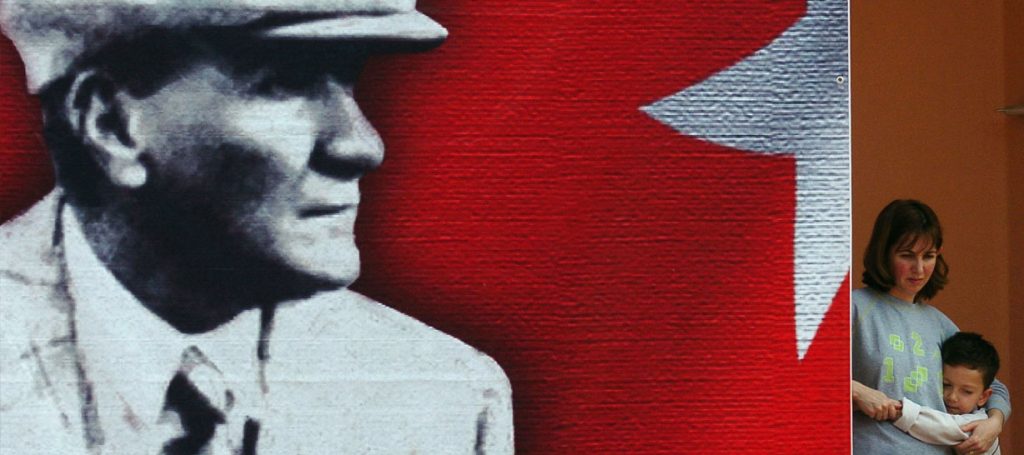
A mother hugs her child most a poster of Ataturk, founder of modern Turkey, during a anti-goverment rally, in western Turkish city of Manisa. Source: Burak Kara/Getty Images
The Atatürk era in Turkey amounted to a unmarried-party regime dominated by Atatürk's People's Republican Party, or CHP. It was not merely an autocratic government that forbade dissent; information technology was besides a revolutionary regime that wanted to transform society. Atatürk's ideological blueprint, which came to be known as "Kemalism," rested on two main pillars: Turkish nationalism and secularism. Both represented a clean suspension from the Ottoman past. Nationalism unsaid a nation-state congenital for Turks, in contrast to the multiethnic Ottoman Empire. And secularism implied that Islam would not exist allowed to have any pregnant public role in this new, modern, Western-oriented democracy.
Atatürk's "revolutions," as they are still praised in Turkish textbooks, were sweeping. The caliphate, an institution that symbolized Muslim political leadership since the Prophet Mohammed, was abolished in 1924, a twelvemonth subsequently the annunciation of the republic. The "Ministry building of Sharia" was disbanded, and Sufi orders and traditional madrasas (Islamic schools) were banned, leaving behind little trace of religion, while mosques were placed nether authorities control. The Ottoman fez was banned and the European-manner brimmed chapeau was imposed past law for government officials. The Islamic agenda was replaced with the Gregorian one, and the Standard arabic alphabet with the Latin. The educational activity of Arabic was banned, every bit was, for a while in the 1930s, the performance of Turkish music. The goal was to make everyone enjoy "modern" (in other words, Western) tunes. Finally, the principle of "laiklik" (adopted from the French "laïcité") was established in the Constitution every bit a key feature of the Turkish Commonwealth, along with other "principles of Atatürk."
These "revolutions" were driven past a conviction shared by the Kemalists: religion, and in item Islam, was an "obstacle to progress." Although they did not explicitly define themselves equally antireligious, the Kemalists insisted that religion belonged in the "conscience of individuals" and not in the public sphere. iv "For Mustafa Kemal and his assembly, the role of Islam in Ottoman society and politics was responsible for the failure to modernize," notes Binnaz Toprak, a Turkish political scientist.
The new republic would undertake a series of reforms both to emancipate the women and to destroy the influence of Islam in educational activity, constabulary, and public administration. At the same fourth dimension, all religious brotherhoods of unorthodox Islam, the folk Islam—which they found to be the force behind the popular ignorance of rational thought—had to be banned in the effort to create a new nation of men and women who would exist guided by positivist ideas of reason. 5
Yet this ambitious effort to create the New Turk would evidence to exist only a half-success, leaving backside non a fully transformed Turkish society, but rather a bitterly divided 1.
The Religious Opposition
Betwixt the two principal pillars of Kemalism, nationalism, and secularism, the former has gained almost universal acceptance in Turkish club—with the notable exception of the largest ethnic minority, which is the Kurds. (While other non-Turkish Muslim ethnic minorities—such equally Bosnians, Albanians, Circassians, the Laz, and the Arabs—alloyed into the larger Turkish torso, about Kurds retained a separate ethnic identity, and reacted to its suppression by the land.) As well that Kurdish exception, whose political expression often claims some 10 percentage of the electorate, nationalism in Turkey is today still the well-nigh powerful political idea and sentiment, cutting beyond party lines, including the Correct-versus-Left or secular-versus-religious divide. Information technology is an assimilationist nationalism that considers all indigenous groups in the nation as "Turks," except the officially recognized non-Muslim minorities such as Christians and Jews, despite the fact that not all of those ethnic groups necessarily self-identify as Turks.
The influence of Kemalist secularism, however, has been more than express. Sure parts of Turkish society, mostly the urban population, welcomed the Kemalist cultural revolution and became its cocky-appointed guardians, to keep the Kemalist revolution intact, generation afterwards generation. The armed services, and other key elements of the Turkish bureaucracy such as the judiciary, became their bastions.
However, the majority of Turks opposed Kemalist secularism. This was repeatedly shown by election results, from the fourth dimension of the start gratis and fair elections in 1950. The majority of Turks voted over and once again confronting staunchly secularist candidates. This majority was largely made upwards of either rural or newly urbanized citizens, who demanded more respect for religion and tradition than the Kemalists were willing to grant. Frequently dubbed as "conservatives," these more traditional Turks repeatedly brought Center-Right parties to power—the Democrat Party in the 1950s, the Justice Party in the 1960s and 1970s, and the Homeland Political party in the 1980s and 1990s. These parties never challenged secularism as such. They but advocated, and tried to implement, a more religion-friendly secularism.
Meanwhile, outright opposition to secularism has been a radical and even illegal concept. The merely place the idea plant a dwelling, often implicitly rather than explicitly, was amidst Turkish Islamists, who appealed to some 10–15 percent of Turkish gild, as indicated by election results and surveys. These Islamists consisted of Sufi orders; the pop "Nur" movement led past Said Nursi (1877–1960), forth with its various offshoots, including the Gulen Movement; intellectuals, some of whom got inspired by the Iranian Revolution of 1979; and ordinary pious Turks who felt humiliated by a Westernized elite. six
Islamist poet Necip Fazıl powerfully expressed the Islamists' feelings in his 1949 poem, "Sakarya." "You are a stranger in your ain dwelling, a pariah in your own state," Fazıl called on to the Anatolian river Sakarya, which stood as a metaphor for the traditional Turk. And at the cease he made a powerful telephone call: "You have crawled too long on your face; get upward on your anxiety, Sakarya!" For decades this line would be reiterated in Islamic rallies by those who longed for the day they would really "get up on their feet," and go their country back.
The term "national" was a euphemism for "Islamic," as Kemalism and all its secular content was seen as a despicable import from the alien W.
Politically, the Islamist energy institute its mainstream expression in the motion led past Necmettin Erbakan (1926–2011), who first appeared in the late 1960s with his National Society Party. 7 The term "national" was a euphemism for "Islamic," as Kemalism and all its secular content was seen as a despicable import from the alien West.
Erbakan's political parties were repeatedly airtight down by the draconian state security courts, only to exist reopened with a new name. In 1996, he became Turkey'due south prime minister for the starting time fourth dimension, thanks to a coalition government with a Middle-Right party, only this only triggered what's ordinarily referred to as Turkey's "postal service-modern insurrection," which began in February 1997 with the military'south ultimatum to the government. The staunchly secular generals who soon forced Erbakan to resign aimed at getting rid of an Islamist regime. But they also aimed at bang-up downward on "irtica"—a loaded Turkish term that literally means "going backwards" and which had become the official term for religious movements that challenged the Kemalist vision of a thoroughly secular society.
Erdogan'due south supporters celebrate outside the AK party headquarters on in Istanbul, Turkey. Source: Jeff J Mitchell/Getty Images
The Headscarf Controversy
During the "mail-mod coup," one of the key aims of the generals was to ban the Islamic headscarf in all schools and public buildings. Their concept followed the French notion of laïcité—French secularism—but took it to even more extreme levels. Accordingly, the presence of religious symbols in the public square had to be banned, for otherwise faith would accept over and suffocate the secular citizens. It was, one could say, a doctrine of preemptive authoritarianism, since information technology was reacting to a speculative future threat, not ane that had actually yet emerged.
The headscarf controversy began in the 1980s, when Turkish universities started experiencing something unprecedented: female students who wore the Islamic headscarf. The new phenomenon was caused by Turkey's social transformation. In earlier decades, the families who would send their daughters to college were almost universally urban secular ones whose culture had little place for a dress lawmaking as conservative equally the headscarf. Meanwhile, the traditional families whose culture did include the headscarf had little involvement in giving college education to their daughters, whose typical pattern was to go married presently later mandatory educational activity.
With the growing urbanization and modernization of the conservative course, however, in that location emerged a new type of bourgeois family that sought higher instruction for its daughters. The more these "turbanites," every bit the secularists dismissively called them, became more numerous and visible, the more the secularists felt uncomfortable. As a outcome, in 1982, under a war machine regime, the newly founded Higher Teaching Council (YOK), whose chore was to oversee all universities, passed a circular order declaring, "All staff and students of institutions of higher education are required to have dress and attire that accord with the revolutions and principles of Atatürk and are of a civilized and modest shape." 8
To make it clearer what "civilized and pocket-sized shape" meant, the YOK further explained that female students had to "take their head uncovered and will not wear a headscarf while in the edifice of the institution."
Thus the "headscarf war" began. Eventually, the disharmonize would become a key symbol of Turkey'south culture war, akin to the controversy over ballgame in the United States. In the side by side 3 decades, secularists tried to impose the ban on the headscarf, which extended from the universities to other public buildings, including sometimes even hospitals. Meanwhile, Islamists, conservatives, and even secular liberals defended the right to wear a headscarf.
A key moment in this boxing was the 1989 decision by the Turkish Ramble Court, which annulled a police passed by parliament a twelvemonth earlier stating that in universities the "hair and neck may be covered with headscarf or turban because of religious beliefs." The courtroom found in this law a violation of the constitutional principle of secularism, which information technology emphatically defined as not separation of state and religion, but rather "a way of life," and a campaign against the "dogmatism of the Middle Ages." The landmark decision read:
Laiklik is a way of life, which bases nationalization, independence, national sovereignty, and the ideal of humanity upon the prevalence of reason, freedom, and republic that developed through the scientific Enlightenment past destroying the dogmatism of the Middle Ages.… Although, in a narrow sense, [laiklik] is defined as the separation of state affairs from those of faith, it is, indeed, widely accepted in the literature that it signifies the last stage of the intellectual and organizational evolution that societies have experienced. Laiklik is a social breakthrough based on sovereignty, democracy, liberty and information besides equally a contemporary regulator of political, social and cultural life… 9
This was a clear statement that Turkish secularism wasn't near the separation of church building and state. Instead, information technology was about the land's duty to secularize society by imposing a "way of life" that had no visible trace of traditional faith.
In 1991, the aforementioned ramble court further explained why Turkish secularism "has a historical particularity" and that it must be practiced "in a dissimilar manner from the West." It as well warned that whatsoever legal attempt past Parliament to set the headscarf free in the public foursquare "bases public regulation upon religious provisions and, thus, is confronting the principle of laiklik." ten
The primary concern of Turkish secularists was liberty from faith, and nigh never freedom of organized religion.
Turkey'south authoritarian secularists purported to take religion as long as it remained in its place, in the censor of individuals, but they institute headscarf-wearing a bridge too far. So too, when religious individuals tried to create civil club organizations based on their organized religion, secularists intervened to supposedly protect "liberty." The main concern of Turkish secularists was freedom from faith, and virtually never liberty of religion.
Sign up for updates.
A Mode Out: Soft Secularism
For whatever serious Muslim with a commitment to practice his organized religion and manifest it in society, Kemalist secularism was difficult to take. It was identified with humiliating bans, and too abiding harassment of Islamic communities and their opinion leaders. Therefore, overthrowing the secular society and enacting in its identify an Islamic authorities became a kind of utopian goal among the Islamists.
Nevertheless, the larger conservative majority found a more pragmatic solution: supporting the forces that advocated a softer, more liberal, more religion-friendly secularism. These forces included Middle-Right political parties, and, especially in the 1990s and onward, "the liberals" as a new intellectual force that defied both the secularism and the nationalism of the Kemalist institution as oppressive doctrines. Amongst these anti-Kemalist circles, the differences between American (or "Anglo-Saxon") and French versions of secularism became an oft-repeated theme.
In the outset decade of the new millennium, the two key principal actors of pro-Islamic politics—the ruling Justice and Development Party (AKP) of Recep Tayyip Erdogan, and its all-time ally at the time, the Gulen Movement—both championed the American way versus the French i. As late as 2014, the pundit Hilal Kaplan, one of the staunchest supporters of Erdogan, was proudly noting that "the majority of Islamist actors and movements in Turkey," including Erdogan's AKP, "accept patterned themselves on the Anglo-Saxon democracies" with the ambition to "constitute individual rights and freedoms." 11
A deeper and more than theoretical approach was offered past the Usa-based Turkish academic Ahmet Kuru with his 2009 volume, Secularism and State Policies toward Religion: The United States, France, and Turkey. 12 Kuru argued that in France and Turkey the dominant credo is "assertive secularism," which aims to exclude religion from the public sphere, whereas in the United States, it is "passive secularism," which tolerates the public visibility of faith. He also argued for the merits of the latter model. The volume was published in English but was also reproduced in Turkish, and supplied the conservative media with helpful intellectual armament against the secularists.
The redefinition of secularism every bit the guarantee of religious freedom has immune the AKP to actualize all the major demands of its religious base without ever challenging the constitutional principle of laiklik. In the early on 2010s the headscarf ban gradually vanished in all state institutions. Sufi orders and other Islamic communities institute more than freedom—and in fact, privilege—than ever earlier, at to the lowest degree equally long every bit they supported the government. In April 2017, Erdogan oversaw a major amendment to the Turkish Constitution, transforming the century-one-time parliamentary system into a presidential ane—but he did not touch on the place of laiklik in the Constitution. Afterward all, the way that laiklik was existence interpreted made information technology increasingly defanged, and it no longer created a major trouble for Turkey'south pro-Islamic majority.
Nevertheless, any objective observer can see that laiklik still creates many problems for other segments of Turkish guild. The Sunni majority keeps enjoying the blessings of state support for their organized religion—evident everywhere from the huge budget of the Directorate of Religious Affairs, which finances all mosques with taxpayer money, to the education system, which includes compulsory pro-Sunni religious education. Minorities can hands feel excluded. Turkey's largest religious minority, the Alevis, exercise not enjoy whatsoever support for their houses of worship. 13 Turkey'southward tiny not-Muslim communities—Armenians, Greeks, Jews, Catholics, Protestants, and Syriac Christians—take seen some progress in their rights during the AKP era, but nearly of them still accept rightful demands that take non been met yet.
Will Turkish Secularism Survive under the AKP?
For most Turkish observers, there is a stark gap between the AKP of the beginning decade of this millennium and that of the 2010s. In the former era, the AKP had a widely appreciated record of liberal political reforms and economic success. That is why the party was supported past a wide range of Turkish and European liberals and was seen by Western capitals or the media as the iconic model of Islamists' capacity to turn into Muslim democrats.
This positive image, however, gradually turned into a grim one in the 2010s. Every bit the AKP consolidated power and became the very establishment it used to struggle with, it lost interest in liberal reforms. The political party tilted toward corruption, nepotism, and ultimately absolutism. All this happened in tandem with the concentration of all power in the easily of Erdogan and the ascension of a cult of personality venerating "The Principal." Every bit of 2018, Turkey had become a case written report of how democracies can devolve into authoritarian regimes.
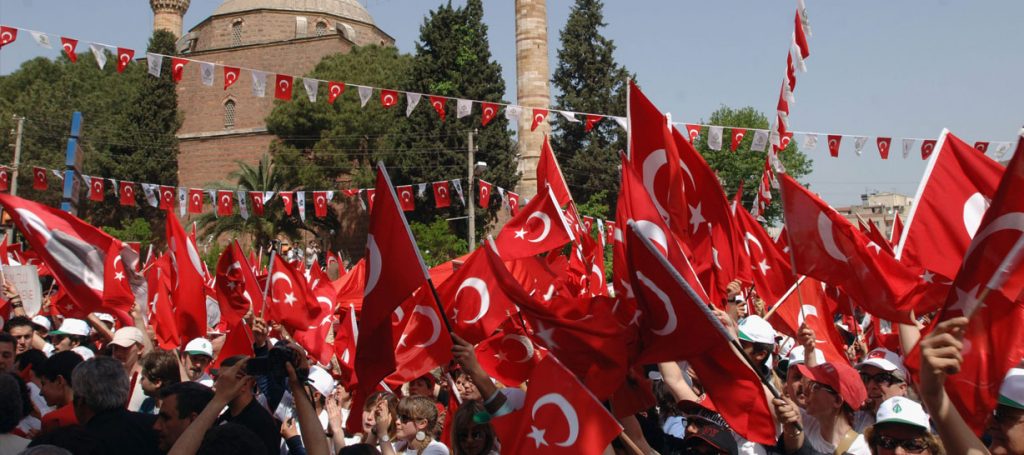
Tens of thousands of Turks moving ridge Turkish flags as they nourish the anti-goverment rally, in western Turkish city of Manis. Source: Burak Kara/Getty Images
There is one irony in this story, though: While the AKP's struggle with laiklik had marked the first decade of the new century, laiklik turned into a non-issue in the following decade. Neither the main opposition party, the CHP, nor other opposition forces blamed the AKP for undermining laiklik whatever longer. Instead, they blamed the party, and especially Erdogan, for other misdeeds, such as cracking down on opposition, silencing the press, making the judiciary subservient, and other themes related to authoritarianism. As for "secularism and religiosity," they have go "not an issue anymore," every bit Speaker of the Parliament Binali Yildirim said in November 2018. 14
These developments, as nosotros have noted, are partly due to the fact that the AKP got from laiklik what it wanted: a reinterpretation of the principle equally merely a basis for the religious freedom of the party's conservative voters. Meanwhile, the CHP realized that the authoritarian secularism that it had championed for decades had only alienated it from the bourgeois majority. The "new CHP" that began to take grade under the leadership of Kemal Kiliçdaroğlu, who has led the party since 2010, toned down the rhetoric on secularism and focused on other issues. (This has led to some increase in the CHP's votes, but not plenty to win elections.)
The AKP got from laiklik what it wanted: a reinterpretation of the principle as merely a basis for the religious freedom of the party'southward bourgeois voters.
Only does this hateful that laiklik has permanently become a non-issue in Turkey, and that pro-Erdogan conservatives are content with a soft secular land that gives them all the religious freedom they want?
It may be too early to answer this question. Beginning, the Erdogan regime may have many years ahead. Second, nosotros have seen that Erdogan has been capable of using different narratives and having unlike allies in the different phases of his political career. A more than explicitly Islamist Erdogan regime thus cannot be ruled out.
An Islamist Roadmap
To go a better sense of what Turkey's new ruling elites call back of secularism, it may be helpful to listen to their opinion leaders, one of whom is Hayretin Karaman. Equally a professor emeritus of Islamic law and a longtime columnist of the Islamist daily Yeni Şafak, he is a prominent authority in Turkey's conservative Islamic circles. He is also a staunch supporter of the Erdogan regime.
In his cavalcade, Karaman has repeatedly addressed the issue of whether living under a secular regime is preferable for Muslims, and, if not, what they are supposed to practice. In one of his about notable pieces, "Living as a Muslim in the Secular Society," he argued that while it is overnice that a democratic–secular system allows Muslims to freely practice their religion, information technology is not plenty. Islam likewise demands "Islamization," Karaman wrote, and that in turn requires that the "flaws" in religious exercise "are kept undercover, and skillful morals are manifest." Therefore, Karaman argued, "it is very difficult for Muslims who live in the laic-secular systems to protect their faith and culture." Sins cannot exist banned and "they tin even be advertised in the media." xv Kahraman does not see the practical incrementalism of Turkey's recent leaders as the mode to achieve these goals. "No doubt, the primal duty is to change the order," he wrote. But he also acknowledged that such full reform "is not hands washed" and requires "following a long and narrow road." In the meantime, he added, governments with a "religious and ideological inclination" can "tilt" toward Islam, while Islamic civil society works difficult to win hearts and minds. xvi
In the Turkey of 2018, one can observe that the soft Islamization Karaman envisioned is already in progress. The AKP authorities is indeed trying to "tilt" guild toward its own understanding of Islam through various measures. These include increasing the number of state-sponsored religious schools; sanitizing the national education organization past excluding themes like the Darwinian theory of evolution; discouraging alcohol consumption with extremely high taxes on alcoholic beverages and banning their advertising and promotion; and imposing "national and spiritual values" on mass media through the grip of the "Radio and Television set Supreme Council." Meanwhile, Islamic civil lodge, with the full support of the government, is thriving in terms of resources and outreach.
This suggests that if the political dominance of Turkey's Islamic camp continues in the years and perhaps decades to come, the "long and narrow route" that Karaman mentioned could then be taken, and secularism can further be eroded to open the fashion for an explicitly Islamic order.
The efforts of Turkish Islamists who hope to see a more than Islamized Turkey are now having an unforeseen result: a powerful secular backlash.
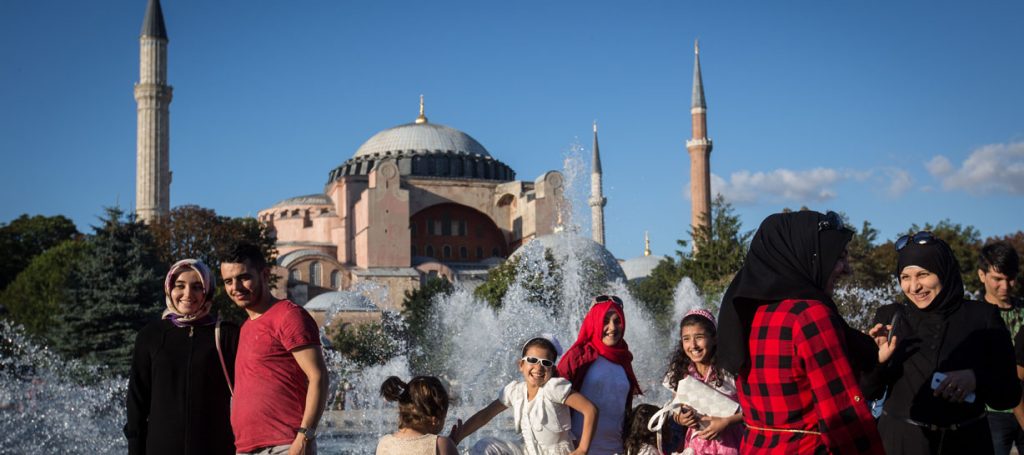
People take photographs in forepart of the Hagia Sofia during celebrations for Eid al-Fitr at Eminonu in Istanbul, Turkey. Source: Chris McGrath/Getty Images
However, the efforts of Karaman and other Turkish Islamists who hope to see a more Islamized Turkey are also having an unforeseen result: a powerful secular reaction. Similar to the conservatives' reaction to Kemalism, many Turks are developing a reaction to the authoritarian, decadent, and crude expressions of Islam that take become associated with Erdogan'southward "New Turkey."
As a result, as I recently explained in an article, "Why So Many Turks Are Losing Faith in Islam," worldviews alternative to Islam, such as deism, are spreading fast in Turkish lodge. Turkey's conservatives, with their usual belief in foreign conspiracies, try to explicate this away as yet some other foreign plot to weaken the nation's spiritual basis. But even some exceptionally self-critical conservatives admit the reality: what has fabricated Islam quite unpopular in the by decade is primarily the behavior of those who claim to act in the organized religion'southward proper noun. This includes scandalously archaic, irrational, bigoted, or misogynist views of some of the religious scholars who accept plant much more than confidence—and air time—than ever earlier. Information technology likewise includes the unabashed exploitation of Islam past politicians—peculiarly those from the ruling AKP. Islamists' ain behavior in positions of power is pushing people abroad from the organized religion they claim to uphold. 17
Fifty-fifty some conservatives admit that Islam's growing unpopularity is due to the scandalously archaic, irrational, bigoted, or misogynist views of some Turkish religious scholars.
Turkish social scientist Volkan Ertit has written that "God is dying Turkey," in line with nigh modern Western societies. In his view, despite the "articulate Islamic sensitivities" of the party that has ruled Turkey since 2002, information shows that "praying rates have decreased, extramarital sexual [relationships have] get prevalent… the belief in virginity is a point of honour for fewer people… [and] traditional family structures have been shattered." He argues that "the classical theory of secularization, which claims that modernization leads to secularization, can all the same explain non but the social transformation seen in historically Christian and Western European countries and their offshoots, but also the social transformation of Turkey." 18
In other words, simply equally Kemalism's attempt to de-Islamize Turkey only proved to be a half success, Erdoganism's nascent effort to re-Islamize Turkey will most likely testify to exist a half-success besides—and, similarly, will but aid farther divide Turkish society, rather than fully transform it.
Toward Evolutionary Secularism
In the tardily Ottoman Empire, de facto secularization aimed to create a non-confessional Ottoman identity that could cover all Ottoman citizens. This liberal effort achieved a lot for its fourth dimension, though it was relatively curt-lived. In contrast, the revolutionary efforts at secularization in Turkey in the modern era produced a whiplash consequence, and proved unable to sustain without authoritarian control. This suggests that the best path to secularization may well be evolutionary, in the mold of the United Kingdom, rather than the revolutionary path, every bit exemplified past France. Constitutional monarchies in the Arab earth today, such as Jordan and Morocco, which are considerably freer than well-nigh Arab states, can exist seen as Ottoman-like models of gradual modernization. 19
Turkey'south story, however, also serves every bit a alarm. Secularization achieved past the wrong means may not give birth to a liberal country, but rather to a draconian 1 unchecked by all traditional constraints likewise as modern ones. The main secular regimes in the Arab earth—the republican dictatorships in Egypt, Syria, and pre-2003 Iraq—are testimonies to this colossal problem.
The secularism of the immature Turkish Republic was just too radical and illiberal to exist accepted by pious segments of Turkish lodge. It did introduce some admirable reforms in a top-down style, such as advancing women's rights, but its absolutism created opposition—an opposition that manifested non simply every bit resistance to the authoritarianism but also to the secularism that came forth with it. This opposition may yet prove to be Turkish secularism's demise. It is unfortunate that this is the main model of secularism the Muslim world has been exposed likewise, whereas the more benign models of the secular state are largely unknown.
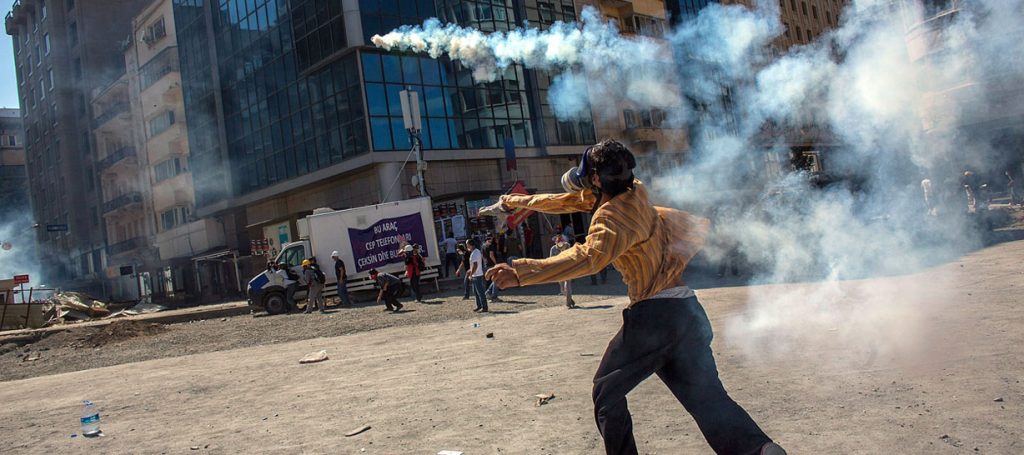
Protesters disharmonism with riot police force during a sit-in near Taksim Square in Istanbul, Turkey. Source: Lam Yik Fei/Getty Images
Admittedly, in that location is a counterargument to the proposition to a higher place: that a height-downwards secularism is necessary to push a securely religious lodge into a secular hereafter. That is how mod values accept root in society, the argument goes, while suppressing some freedoms for the greater good. (This is the statement of "benevolent absolutism," often made by the Kemalists.) Since the alternative of liberal secularism in a deeply religious gild has never been tried in the Muslim world, it is hard to weigh this argument. Ultimately, one'due south subjective preference may depend on what ane prioritizes: liberalism or secularism. (This author prioritizes the quondam.)
The Turkish conservatives' longtime preference for an American-blazon liberal secularism provides a promising lesson, showing how Islam can be compatible with a secular order. The literature produced in Turkey about this Islamic-liberal synthesis is worth exploring and expanding. However, it is likewise true that no thing how Islam-friendly a secular model is, it will non be enough for Islamists who believe that organized religion—and its "morals"—should dominate the public space. For liberal secularism to thrive, mainstream classical Islam, equally articulated by jurists such as Karaman, must have reformist steps to abandon this deep-seated triumphalism, and to accept being merely one of the competing value systems in an open guild.
This policy report is part of Citizenship and Its Discontents: The Struggle for Rights, Pluralism, and Inclusion in the Middle East, a TCF projection supported by the Henry Luce Foundation.
Cover Photo: Anti-government protestors ride a ferry boat from the Asian to the European side of Istanbul in social club to get to Taksim Square on in Istanbul, Turkey. Source: Uriel Sinai/Getty Images
Notes
Fazlur Rahman, Islam and Modernity: Transformation of an Intellectual Tradition (Chicago: University of Chicago Press, 1982), 156.
"The Ottoman Constitution (23 December 1876)," Türk Anayasa Hukuku Sitesi (Turkish Ramble Law Website), accessed December 3, 2018, http://www.anayasa.gen.tr/1876constitution.htm,
Encounter Selim Deringil, "'There Is No Compulsion in Religion': On Conversion and Betrayment in the Late Ottoman Empire: 1839–1856," Comparative Studies in Society and History 42, no. three (July 2000): 547–75. The quote uses a common English term for "Muslim" from the nineteenth century
More literally, Recep Peker, the general secretary of Atatürk's CHP, said in 1936: "In Turkey, religious considerations cannot become across the skin of the torso of the denizen… Information technology has no place in order, administration or politics." (Recep Peker, "Uluslaşma-Devletleşme," Ülkü Halkevleri Mecmuası 7, no. 41 (July 1936): 3. Over the decades, the idea that religion tin can exist "only in the conscience of individuals" became common parlance in Kemalist Turkey.
Binnaz Toprak, "Secularism and Islam: The Building of Modern Turkey," Macalester International 15, art. nine (2005), http://digitalcommons.macalester.edu/macintl/vol15/iss1/9.
The Gulen Motility became a decisive political histrion in the 2010s, with its immense power in the bureaucracy, equally first the best marry so the worst enemy of the Justice and Development Party governments led by Erdogan. The group's apparent interest in the failed coup effort in 2016 totally criminalized and delegitimized it inside Turkey, leaving information technology with room to maneuver only abroad, specially in the West.
Known in Turkish as "Milli Nizam Partisi."
Dilek Cindoğlu, "Headscarf Ban and Bigotry: Professional Headscarved Women in The Labor Market," Turkish Economic and Social Studies Foundation (Istanbul: TESEV Publications, 2011), 34, http://tesev.org.tr/wp-content/uploads/2015/11/Headscarf_Ban_And_Discrimination.pdf.
"The Changing View of the Turkish Constitutional Court in Defining the Laiklik," Political and Social Research Institute of Europe, accessed December 7, 2018, http://ps-europe.org/the-changing-view-of-the-turkish-constitutional-court-in-defining-the-laiklik/. Some grammatical corrections accept been made to the quoted translation.
"The Irresolute View of the Turkish Constitutional Court."
Hilal Kaplan, "'Secularist' Erdoğan," Daily Sabah, July sixteen, 2014, https://www.dailysabah.com/columns/hilal_kaplan/2014/07/sixteen/secularist-erdogan.
Ahmet Kuru, Secularism and State Policies toward Religion: The U.s.a., French republic, and Turkey (Cambridge: Cambridge Academy Press, 2009).
Alevis share many behavior with Shia Islam, though most practice non identify as Shias. They follow a less legalist interpretation of Islam, where strict rules and rituals are replaced with moral preaching and unorthodox rituals such as the "cem," which brings men and women together for a folkloric trip the light fantastic toe.
"Laik-dindar çatışması geride kaldı" (The Religious-Secular Conflict Is a Thing of the Past), Yeni Şafak, November sixteen, 2018, https://world wide web.yenisafak.com/gundem/laik-dindar-catismasi-geride-kaldi-3409096.
"Laik Düzende Müslümanca Yaşamak" (Living as a Muslim in the Secular Society), Yeni Şafak, June 3, 2016, https://www.yenisafak.com/yazarlar/hayrettinkaraman/laik-duzende-muslumanca-yaamak-2030153.
"Living as a Muslim in the Secular Order."
"Why So Many Turks Are Losing Faith in Islam," Al-Monitor, April sixteen, 2018, http://world wide web.al-monitor.com/pulse/originals/2018/04/turkey-why-so-many-turks-are-losing-organized religion-in-islam.html.
Ertit, "God Is Dying in Turkey as Well: Application of Secularization Theory to a Not-Christian Club," Open Theology 4, no. 1 (2014): 192–211.
That Kingdom of morocco and Jordan are freer than most Arab states (with the single exception of Tunisia) is suggested past the "Liberty in the World" map by Freedom Firm, (accessed December vii, 2018), https://freedomhouse.org/report/freedom-world/liberty-world-2018, as well equally the Cato Institute's Man Freedom Index (accessed Dec 7, 2018), https://world wide web.cato.org/homo-freedom-index.

0 Response to "When Has Islam Become Present in Turkey Again Mustafa Kemal Economic Reforms"
Post a Comment